
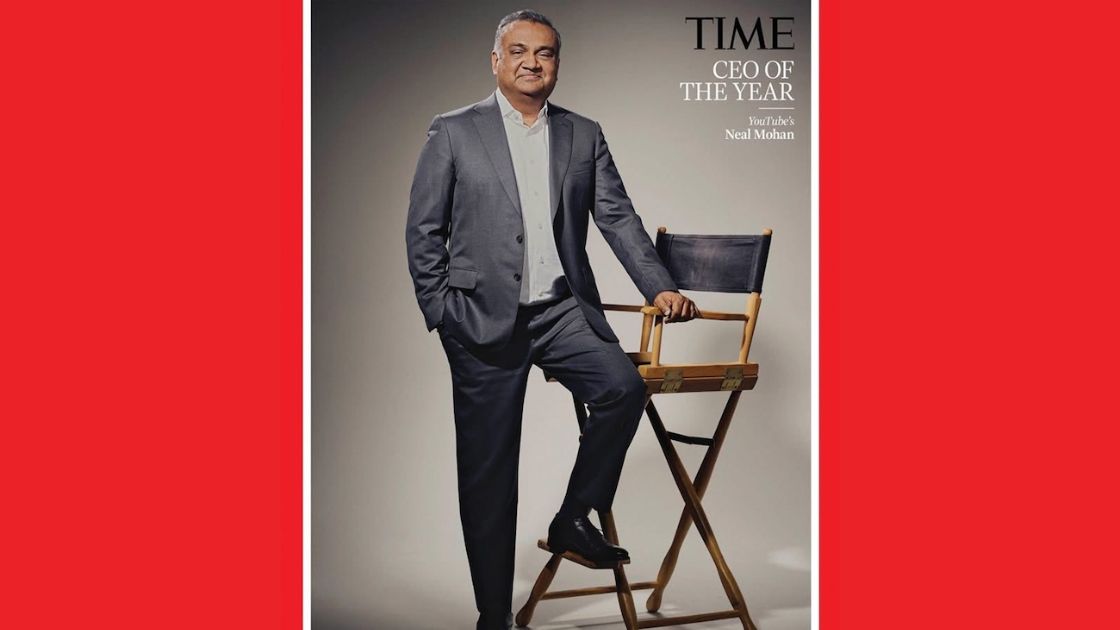
YouTube CEO Neal Mohan has been named TIME Magazine’s 2025 CEO of the Year, with the publication praising the Indian-American leader as the mastermind behind the content that billions of people around the world watch, create, and engage with.
TIME’s profile, published on December 9, describes how “YouTube is shaping the cultural diet that the world is increasingly consuming,” and lauds Mohan as the “farmer” cultivating the content that defines modern media.“What he chooses to cultivate will ultimately shape what we consume,” TIME writes.
This honor marks a significant milestone for the 52-year-old executive, who has skillfully guided YouTube through a transformative period since taking over in February 2023. Mohan succeeded the late Susan Wojcicki, and under his leadership, the platform has continued to evolve and maintain its dominance in the global digital landscape.
The Meteoric Rise Under Mohan
Since Mohan took the helm as CEO, YouTube has strengthened its dominance on multiple fronts. According to TIME and company executives, the platform generated more than $36 billion in advertising revenue in 2024, alongside an additional $14 billion from subscriptions. Momentum continued into 2025: advertising revenue rose 15% in the first three quarters, while subscriptions to YouTube Music and YouTube Premium surged 25% year over year by March.
Today, over 2 billion people—roughly a quarter of the world’s population—visit YouTube daily, TIME reports. They encounter a nonstop stream of content, with more than 500 hours of video uploaded every minute. The range is vast, spanning everything from a Scottish veterinarian treating infected cow hooves, to NBC News coverage, to releases from Bollywood superstar Aamir Khan, who famously rejected a multimillion-dollar streaming deal to debut his film on YouTube as a pay-per-view release.
Business Chief North America reported that under Mohan’s leadership, YouTube has transformed from a primarily mobile-first app into a powerhouse on television screens. For many households, it now serves as a full-fledged replacement for cable TV—while remaining free to use. At the same time, the launch of YouTube Shorts has sharpened the platform’s competitive edge, positioning it more directly against rivals like Instagram and TikTok.
A Surprisingly Mellow Leader
TIME described the head of what it called “the world’s most powerful distraction machine” as “surprisingly mellow.”
“He’s soft-spoken, thoughtful, and difficult to unsettle,” the magazine observed.“He likes watching sports, going to his daughters’ dance recitals, and wearing open white shirts—simple, everyday pleasures.”
The Tribune of India reported that Mohan often describes his and his colleagues’ work as building the world’s best stage for people to perform on. Business Chief characterized his leadership style as an “uncle-level” approach—calm, composed, and exceptionally steady in maintaining balance.
“YouTube today is more like a vast metropolis, with countless interconnected dependencies—what happens on one street ripples across others,” Mohan told TIME during an interview at YouTube’s headquarters in San Bruno, California. “In its early days, it was much more like a village, where many creators knew one another.” Leading one versus the other forces you to think about decisions in fundamentally different ways.”
From Lucknow to Silicon Valley
Born in 1973 in Lafayette, Indiana, to parents from Lucknow, Mohan spent part of his early childhood in the United States before moving to India in 1985 at the age of 12, according to The Tribune. He studied at St. Francis’ College in Lucknow, where he learned Hindi and Sanskrit—an experience that later helped shape his analytical and reflective approach to problem-solving.
Mohan studied at St. Francis’ College in Lucknow, where he learned Hindi and Sanskrit—an experience that helped shape his analytical way of thinking.
“It’s incredibly phonetic and rules-oriented,” Mohan told TIME of learning Sanskrit. “It was like learning computer programming, basically.”
Business Standard reported that this early education in India gave Mohan a distinctive perspective that later informed his global leadership style. He eventually returned to the United States for higher studies, earning a Bachelor of Science in electrical engineering from Stanford University, followed by an MBA from Stanford Graduate School of Business. At Stanford GSB, he was named an Arjay Miller Scholar, an honor awarded for academic excellence, according to News Mobile.
The Path to YouTube
According to Business Chief, Mohan began his professional career in 1996 as a Senior Analyst at Accenture (then Andersen Consulting) soon after graduating from Stanford. A year later, he joined internet advertising startup NetGravity, which was acquired by DoubleClick in 1997—marking Mohan’s entry into the digital advertising industry.
At DoubleClick, he advanced through several leadership roles, including Director of Global Client Services and later Vice President of Business Operations. When Google acquired DoubleClick in 2008, Mohan joined Google as part of the deal.
“The DoubleClick acquisition also introduced Mohan to Susan Wojcicki, who was then in charge of Google’s advertising business,” TIME reported.“She was the person at Google who pushed hardest for that acquisition. I’ve had a very long history with her and consider her one of my closest friends and mentors.”
When Wojcicki took over as CEO of YouTube in 2014, she brought Mohan along with her into the company’s top leadership. According to TIME, he was among the few people she confided in about the cancer that ultimately led to her death in August 2024. During her treatment, Mohan stepped in to handle many of her responsibilities and formally took over leadership when she stepped down to focus on her health and family.
AI and the Creator Economy
Artificial intelligence has become a central pillar of Mohan’s strategy. Business Standard reported that in September, YouTube rolled out more than 30 AI-powered tools—three times the number introduced the previous year. Mohan said AI can help restore some of YouTube’s early momentum by lowering barriers for new creators while also strengthening safety and moderation systems.
YouTube is both shaping and benefiting from what TIME described as a “massive marketing shift toward the creator economy.” A recent trade-group report cited by the magazine projected that advertisers will spend $37 billion on creators in 2025, a 25% increase over 2024.
“I’m a technologist by both passion and training,” Mohan told TIME. “I also have a deep love for media in the traditional broadcast sense.” Building products—whether in advertising or at YouTube—is really my passion.”
The Garden Metaphor
TIME used a vivid metaphor to describe YouTube’s cultural impact under Mohan’s leadership:
“YouTube offers the soil, and everyone plants whatever they wish—whether nourishing or harmful.” As the garden spreads across the planet—sometimes threatening old-growth forests—whatever grows there becomes what people consume, because it’s what’s available and often what’s free.”
The magazine noted that Mohan’s core value is “helping people get heard.” According to The Tribune, Mohan has framed his approach to moderation this way:
“My guiding principle for content policies and moderation on YouTube is to ensure that everyone has a voice.”
High-Profile Endorsements
NFL Commissioner Roger Goodell praised Mohan’s preparedness and strategic clarity.
“I would say Neal is very well prepared,” Goodell told TIME. “He understands what he’s trying to build. He has a deep understanding of the media landscape, where YouTube fits, and how content can help advance his broader strategies.”
According to TIME, a series of major moves this year reinforced YouTube’s status as a powerful starmaking engine. MrBeast’s game show on Amazon Prime is set to return for a second season in January, while Netflix struck high-profile deals with creators Ms. Rachel and Mark Rober. Twenty-year-old creator Kane Parsons also crossed into prestige filmmaking through a collaboration with studio A24. Behind the scenes, Mohan even relied on his understated persuasion, meeting with Emmy voters to encourage greater recognition of YouTube’s homegrown stars.
The Living Room Takeover
TIME observed that YouTube has “spread to the biggest screen in the house and into nearly every genre of entertainment.” By 2025, the platform had firmly established itself in the living room, with YouTube TV emerging as a preferred alternative to traditional cable subscriptions.
The platform’s growing influence over mainstream entertainment was further underscored by Bollywood star Aamir Khan’s choice to release his film on YouTube as a pay-per-view offering rather than accept a multimillion-dollar streaming deal, TIME reported.
In an era when tech leaders are known for high-octane pursuits—from Brazilian jiu-jitsu to space tourism—TIME noted that “Neal Mohan is focused on one thing. He just runs YouTube.”
For Mohan, that singular focus is intentional. “The dynamics of the entire media industry are changing before our eyes,” he told TIME. “It’s incredibly disruptive, and if you don’t adapt, you can be left behind.”
Net Worth and Recognition
According to News Mobile, while estimates vary, Mohan’s net worth is believed to be around $50 million, largely accumulated through his long tenure at Google/Alphabet and YouTube. Before becoming CEO, he oversaw several key products, including YouTube Music, YouTube Premium, and YouTube Shorts.
His CEO of the Year recognition adds to the growing acknowledgment of Indian-origin leaders shaping global technology. News Mobile described the honor as “a milestone for Indian-origin executives in Silicon Valley and a reflection of India’s central role in the future of the creator economy.”
The Stakes of Cultural Curation
TIME’s profile emphasized the immense responsibility tied to Mohan’s role. As the de facto mayor of what the magazine called a “global megalopolis,” his decisions influence what billions of people watch every day.
“One of his primary responsibilities is to project a calm, genial steadiness rather than slick charisma,” TIME observed, noting that such an approach is well suited to a platform where trust and stability must be maintained amid constant change.
Ultimately, TIME’s garden metaphor captures both the promise and the risk of Mohan’s position: he tends the soil but cannot fully control what grows—only whether conditions encourage nourishing growth or harmful weeds. Navigating that balance defines the challenge of leading one of the world’s most influential platforms.
For now, TIME’s recognition suggests Mohan has met that challenge with skill—expanding YouTube’s reach and cultural influence while preserving the calm, deliberate leadership style that defines him, proving that in the attention economy, the quietest presence can sometimes wield the greatest power.