
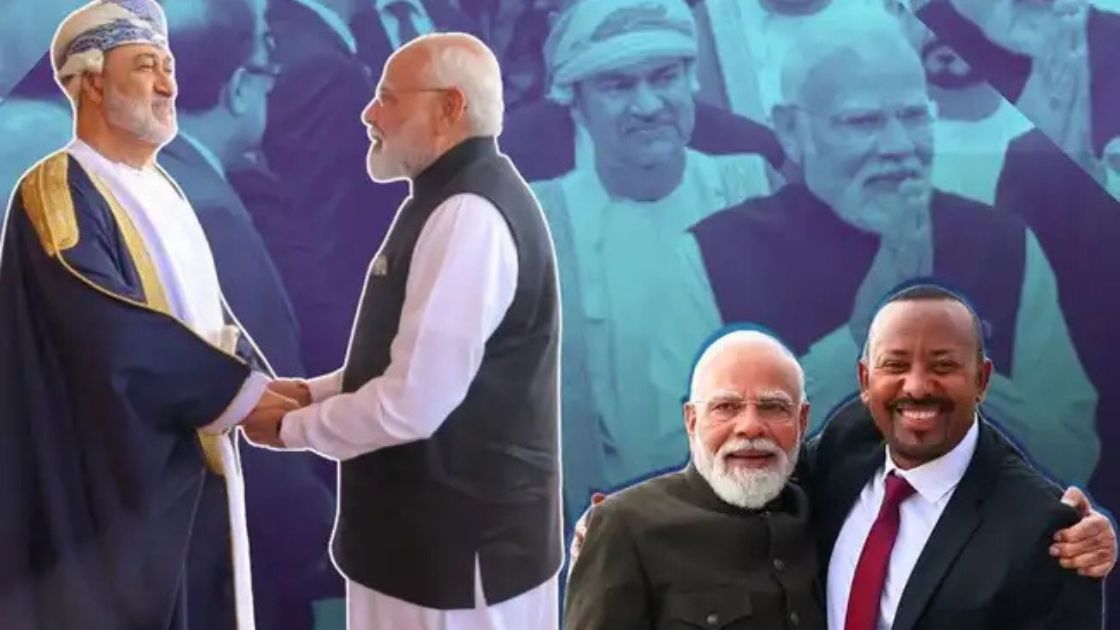
If Prime Minister Narendra Modi’s December tour is traced on a map, a deliberate geopolitical geometry comes into focus.
Positioned on the eastern edge of the Arabian Peninsula, at the crossroads of West Asia, and anchoring the Horn of Africa respectively, Oman, Jordan, and Ethiopia together form a triangle connecting the Gulf, the Levant, and Africa.
The visits followed a tightly coordinated sequence: Jordan from December 15–16, Ethiopia from December 16–17, and Oman from December 17–18.
What initially appears geographic is, in fact, strategic. Each stop reinforced a distinct pillar of India’s foreign policy: trade and mobility in the Gulf, political stability and resources in West Asia, and long-term influence in Africa and the Global South.
Taken together, the visits reveal how India is weaving its influence through economic, political, and people-to-people ties.
Oman and Jordan: The Gulf–Levant Hinge
The India–Oman Comprehensive Economic Partnership Agreement (CEPA), signed in the presence of Prime Minister Modi and Sultan Haitham bin Tarik, marks India’s sixth free trade agreement in five years—and its second in just six months, following the pact with the United Kingdom.
It is also Oman’s first bilateral trade pact since 2006, underscoring the political importance Muscat places on its partnership with New Delhi.
Key data points:
- Tariff concessions: Zero-duty access on 98.08% of Oman’s tariff lines, covering 99.38% of India’s exports by value.
- Sectors set to benefit most: Textiles, leather, footwear, gems and jewellery, engineering goods, plastics, furniture, agriculture, pharmaceuticals, medical devices, and automobiles.
- Current trade: India exports about $4.1 billion annually to Oman—mainly refined petroleum, machinery, alumina, rice, and steel—some of which previously faced duties as high as 100%.
- Services liberalisation: 127 sub-sectors have been opened, including IT, business services, education, healthcare, research, and audio-visual industries. The agreement also eases entry and allows longer stays for Indian professionals, extending permitted stays for contractual service suppliers from 90 days to two years.
- Investment: Oman will allow 100% foreign investment across major services sectors, with plans to hold discussions on coordinating social security frameworks.
“While more than 80% of Indian goods already enter Oman at an average tariff of around 5%, duties on some items run as high as 100%. Their elimination under the CEPA is expected to enhance price competitiveness for Indian exporters, though growth prospects are moderated by the relatively small size of Oman’s domestic market,” said Ajay Srivastava of GTRI.
Beyond trade volumes, more than 6,000 Indian firms operate in Oman, remittances amount to roughly $2 billion annually, and bilateral trade already exceeds $10 billion, according to the government. The agreement formalises an economic relationship that has been quietly deepening for decades.
For Jordan—a smaller yet pivotal player in West Asia—Modi’s December 15–16 visit marked his first full-fledged bilateral trip and the first by an Indian prime minister in 37 years, coinciding with the 75th anniversary of diplomatic relations established in 1950.
Key outcomes and figures:
- MoUs signed (5): Covering renewable energy, water resource management, cultural exchange, digital solutions, and the twinning of Petra and Ellora—reflecting a blend of hard cooperation and soft power.
- Trade: India is Jordan’s third-largest trading partner, with both sides setting a bilateral trade target of $5 billion over the next five years.
Fertilisers: Jordan supplies phosphates and potash to India.
Jordan India Fertiliser Company: Valued at $860 million.
Additional agreements: Deals with Jordanian producers worth $1.5 billion bolster India’s food security strategy.
Garments: More than 15 NRI-owned companies operate in Jordan’s Qualified Industrial Zones, investing roughly $500 million.
Defence: Building on a 2018 MoU, cooperation has grown through exhibitions and naval visits.
Science & Technology: The Indian–Jordan Centre of Excellence in IT at Al-Hussein Technical University is expected to train around 3,000 professionals.
During discussions between Prime Minister Modi and King Abdullah II, both leaders reaffirmed their commitment to combating terrorism and expressed shared concerns about regional instability, highlighting Jordan’s role as a moderate and stabilizing voice in a turbulent region.
Ethiopia: The African Anchor
While Oman and Jordan anchor India’s engagement in the Gulf and West Asia, Ethiopia provides the triangle with strategic depth in Africa. Prime Minister Modi’s December 16–17 visit marked his first bilateral trip to the country. During the visit, he was awarded the Great Honor Nishan of Ethiopia, and both nations elevated their ties to a Strategic Partnership.
India’s economic presence in Ethiopia is significant. More than 675 Indian companies are registered with the Ethiopian Investment Commission, with cumulative investments exceeding $6.5 billion in sectors such as manufacturing and pharmaceuticals, generating over 75,000 local jobs. Although bilateral trade remains modest at $550.19 million in FY 2024–25, it is largely driven by Indian exports.
Agreements and Cooperation from Modi’s Visit
Prime Minister Modi’s visit resulted in the signing of eight Memoranda of Understanding (MoUs), marking a significant expansion of bilateral cooperation. Key agreements included the establishment of a data centre at the Ministry of Foreign Affairs and debt restructuring under the G20 Common Framework.
The MoUs also broadened collaboration across trade, defence, digital infrastructure, health, traditional medicine, mining, and critical minerals. In addition, both sides agreed to institutionalize engagement through Foreign Office Consultations, Joint Trade Committee meetings, and coordinated participation at G20 and BRICS summits.
“When spider webs unite, they can tie up a lion,”
Prime Minister Narendra Modi told Parliament in Addis Ababa, underscoring the depth of India–Ethiopia relations and conveying a broader message about the power of collective strength.
Invoking an Ethiopian proverb during his address to Parliament in Addis Ababa, Prime Minister Narendra Modi underscored the power of unity and cooperation. Drawing parallels with Indian philosophy, he emphasized that collective strength enables nations to overcome even the greatest challenges, reaffirming India and Ethiopia’s shared identity as Global South partners, ancient civilizations, and close friends.
The message gained added significance amid growing global trade uncertainty, driven by a renewed wave of protectionism under US President Donald Trump. In August, Washington imposed steep 50% tariffs on Indian goods, sharply restricting exports to India’s largest overseas market.
The tariffs remain in place despite months of negotiations, even as Indian exports to the US increased to $59.04 billion during April–November 2025, up from $53.01 billion in the same period a year earlier.
In response, India has stepped up efforts to build a network of free trade agreements (FTAs) to diversify its export destinations and lessen reliance on the US. Talks with the European Union, New Zealand, and Chile are reported to be at an advanced stage.
India is strategically deploying free trade agreements to broaden its export base and cushion the effects of high and unpredictable U.S. tariffs, trade analyst Ajay Srivastava told the Associated Press.
India currently has 15 free trade agreements covering 26 countries, along with six preferential trade agreements with another 26 nations, and is in negotiations with over 50 additional partners. Recent FTAs with the UAE and Australia have already expanded trade flows, while a long-pending agreement with Britain was finalised this year.
Africa: India’s Strategic Trade Frontier
Ethiopia anchors India’s Africa strategy, offering scale, investment opportunities, and diplomatic clout within the Global South. With 54 nations making up nearly a third of the UN General Assembly, Africa is key to building coalitions and influencing global norms.
India engages Africa pragmatically, viewing the continent not merely as a market but as a partner across manufacturing, pharmaceuticals, agriculture, ICT, energy, and critical minerals, while also supporting maritime security and resilient supply chains.
Africa: A Strategic Partner in India’s Global South Vision
Africa lies at the heart of India’s Global South strategy, serving as a strategic partner in development, energy and resource security, trade expansion, and multilateral cooperation. With 54 nations and rising economic and geopolitical influence, the continent is pivotal in shaping global governance reforms aligned with Global South priorities. For India, Africa offers strong complementarities in manufacturing, pharmaceuticals, agriculture, ICT, energy, and critical minerals, while also acting as a key pillar of strategic engagement.
Modi’s visit to Ethiopia follows earlier trips to Ghana, Namibia, and South Africa, all aimed at expanding trade beyond traditional markets and establishing alternative supply chains. Viewed in this context, the December 2025 tour was less a series of stops and more a clear statement of intent.
By reinforcing trade frameworks in Oman, deepening political and resource ties with Jordan, and positioning Ethiopia as a strategic partner, Modi outlined a triangle of influence linking regions often viewed in isolation.