
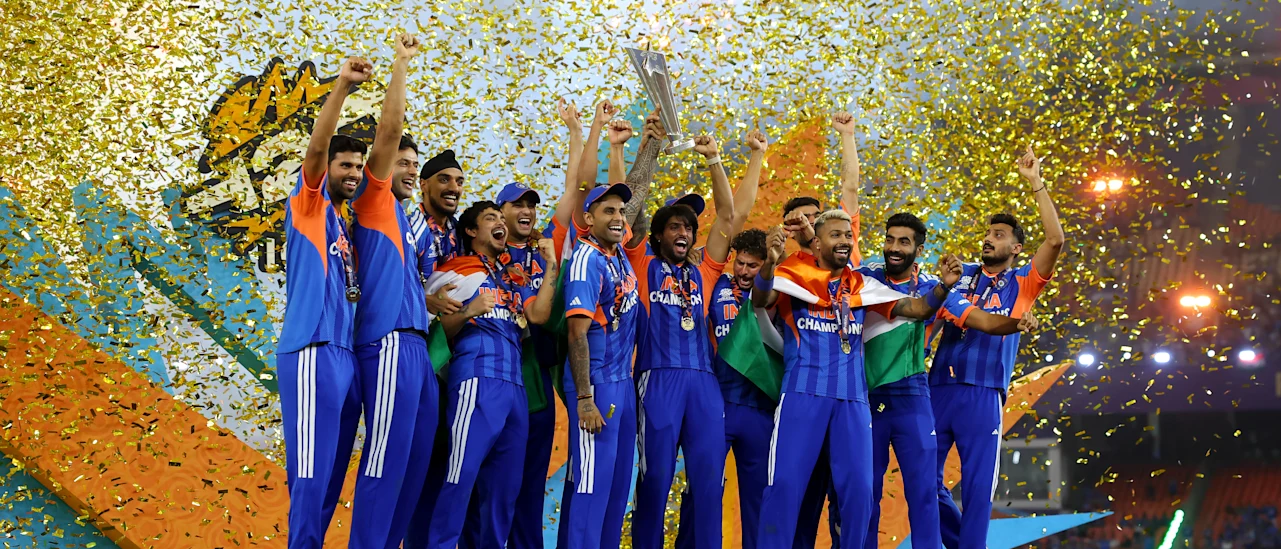
Ahmedabad, 2026 — When the dust settled at the Narendra Modi Stadium, one thing was crystal clear: India didn’t just win the T20 World Cup final—they owned it. In a breathtaking display of power-hitting and calculated aggression, the Men in Blue dismantled New Zealand to script history and lift the coveted trophy.
The Sanju Samson Show Continues
If there’s one player who defined India’s campaign, it’s Sanju Samson. The wicketkeeper-batter once again proved why he’s the man for the big occasion, anchoring the innings with a blistering 89 off just 46 balls.
What made this innings special? It was his third consecutive half-century—and his third consecutive score above 80 in this tournament. Only the legendary Mahela Jayawardene (in 2010) had achieved this feat before in T20 World Cup history. Samson also joined an elite club of players who’ve scored 50+ in both the semi-final and final of a T20 World Cup.
With 5 fours and 8 sixes, Samson wasn’t just batting; he was orchestrating a symphony of destruction.
Sharma’s Explosive Start
While Samson played the anchor, Abhishek Sharma provided the fireworks. Rising to the occasion despite a patchy start to the tournament, Sharma smashed the fastest fifty of the tournament—off just 18 balls. His innings of 52 off 21 balls included 6 fours and 3 sixes, giving India the rocket start they needed.
Together, Samson and Sharma created history: the first opening pair to put on a 50+ stand in a T20 World Cup final. Their 98-run partnership laid the foundation for what would become a record-breaking total.
Powerplay Carnage
India came out swinging, and New Zealand had no answers. The fourth over alone yielded 24 runs, and by the end of the powerplay, India had raced to 92 runs—the highest powerplay score of this World Cup and joint-highest in T20 World Cup history.
New Zealand’s usually reliable Matt Henry lost his composure, conceding four wides in the fifth over. In fact, the Black Caps bowled 8 extra deliveries in the powerplay—the most they’ve ever conceded in T20 internationals. Their pace-heavy strategy in Ahmedabad? Completely backfired.
Kishan Keeps the Momentum
Even after Sharma’s departure, there was no respite for New Zealand. Ishan Kishan joined Samson and the duo went “hell for leather,” adding 105 runs in just 48 balls for the second wicket. Kishan’s 54 off 25 balls (4 fours, 4 sixes) ensured India never lost momentum.
Lockie Ferguson, one of New Zealand’s premier fast bowlers, was taken to the cleaners—48 runs conceded in just 2 overs. It was that kind of day for the Black Caps.
The Brief Hiccup
James Neesham provided a moment of hope. In the 16th over, he dismissed Samson (off a full toss), followed by Kishan and Suryakumar Yadav in quick succession. From a commanding 203/2, India slipped to 204/4. For a brief moment, New Zealand sensed a way back.
Dube’s Finishing Flourish
Enter Shivam Dube. With two overs remaining, Dube unleashed mayhem—striking 3 fours and 2 sixes to plunder 24 runs in the final over. India crossed the 250-mark, finishing with a mountain of runs.
The boundary count told the story: 19 fours and 18 sixes, totaling 184 runs in boundaries alone.
What This Means
This victory cements India’s legacy in T20 cricket. It’s not just about the trophy—it’s about the manner of the victory. Dominant, fearless, and utterly convincing. From Samson’s consistency to Sharma’s explosive start, from Kishan’s support to Dube’s finishing, it was a complete team performance.
New Zealand, despite their big-match experience, were simply outplayed. Their bowling attack, usually their strength, crumbled under the relentless Indian onslaught.
Final Word: India didn’t just chase World Cup glory—they grabbed it with both hands and never let go. Champions, indeed. 🏆