
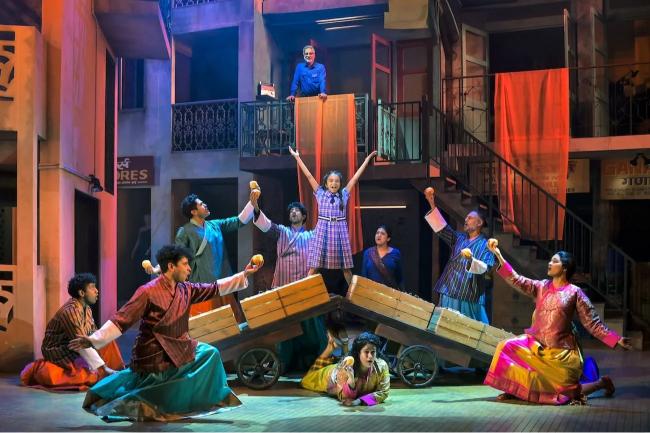
Some stories are too beautiful to stay in one form.
The Lunchbox—Ritesh Batra’s 2013 masterpiece that captivated audiences worldwide with its quiet tale of mistaken delivery and unexpected connection—has now been reborn as a stunning musical play, and the results are nothing short of enchanting.
From the bustling dabbawala networks of Mumbai to the intimate emotional landscapes of two lonely souls, this theatrical adaptation doesn’t just retell the story—it elevates it through song, movement, and live performance that breathes new life into every moment.
🎬 From Screen to Stage: A Labor of Love
The Original Film: A Global Phenomenon
Before the musical, The Lunchbox was already a cultural touchstone: ✅ Premiered at Cannes Critics’ Week (2013) to standing ovations
✅ Won the Grand Rail d’Or and Audience Award
✅ Grossed over $24 million worldwide on a modest budget
✅ Introduced global audiences to the poetry of everyday Indian life
The Musical Adaptation: Why Now?
Creator Ritesh Batra and composer A.R. Rahman (reportedly in talks) saw an opportunity: 🔹 Intimacy Amplified: Live performance brings audiences closer to the characters’ emotional journeys
🔹 Music as Memory: Songs deepen the resonance of moments that lingered in the film
🔹 Cultural Celebration: The dabbawala system, Mumbai’s rhythms, and Indian culinary traditions come alive through choreography and sound
“The Lunchbox was always a story about connection—through food, through words, through hope. Music is the most universal language of connection. It felt like the next natural step.”
— Ritesh Batra (paraphrased)
🎵 What Makes the Musical Special?
✨ The Score: Melodies That Carry Memory
Early reports suggest the musical features:
- Original compositions blending Indian classical motifs with contemporary theatrical styles
- Reimagined versions of beloved film tracks, expanded for ensemble performance
- Leitmotifs for characters that evolve as their relationship deepens
🎭 Staging: Mumbai on Stage
The production design reportedly captures:
- The kinetic energy of Mumbai’s lunchbox delivery system through synchronized movement and percussion
- Intimate domestic spaces that shift seamlessly between Saajan’s quiet apartment and Ila’s bustling kitchen
- Projection mapping to evoke the city’s monsoons, markets, and midnight skies
💃 Choreography: Dance as Dialogue
Rather than traditional Bollywood spectacle, the choreography is said to be:
- Subtle and expressive, using gesture and rhythm to convey unspoken emotions
- Integrated with storytelling, where a dabbawala’s route becomes a ballet of precision and purpose
- Culturally authentic, drawing from folk traditions while embracing contemporary theatrical movement
👥 The Characters: Reimagined for Live Performance
📦 Ila (The Young Housewife)
- Her loneliness and hope are expressed through solos that blend longing with resilience
- Kitchen scenes become rhythmic sequences where cooking is choreographed like dance
- Her letters to Saajan gain new dimension through musical monologues
📚 Saajan Fernandes (The Retiring Office Worker)
- A character defined by silence in the film finds voice through baritone ballads of regret and rediscovery
- His transformation is marked by shifting musical themes—from minor keys to hopeful major chords
- Office routines become stylized ensemble numbers reflecting the monotony—and unexpected beauty—of daily life
🚴 The Dabbawalas (The Silent Connectors)
- Elevated from background to essential chorus, representing the invisible networks that hold a city together
- Their precision delivery system is celebrated through percussive, high-energy sequences
- Serve as narrative guides, bridging scenes and offering philosophical commentary through song
🌍 Why This Adaptation Matters
For Fans of the Film
✅ New Layers: Music reveals emotional subtext that enriches familiar moments
✅ Live Connection: Experiencing the story in real time creates a shared, communal magic
✅ Cultural Pride: Seeing an Indian story celebrated on global theatrical stages
For Theater Lovers
✅ Fresh Storytelling: A non-Western narrative brought to life with authentic cultural specificity
✅ Innovative Form: Blends Indian performance traditions with contemporary musical theater
✅ Universal Themes: Love, loneliness, and hope—told through a uniquely Indian lens
For the Diaspora
✅ Representation: A nuanced, non-stereotypical Indian story on international stages
✅ Intergenerational Appeal: Bridges parents who loved the film with children discovering theater
✅ Cultural Continuity: Celebrates traditions (dabbawalas, home cooking, letter-writing) while embracing modern artistic forms
🎟️ What to Expect: Practical Details
(Note: Specific casting, venues, and dates vary by production. Check local listings for your nearest performance.)
📍 Likely Production Hubs
- Mumbai: World premiere at National Centre for the Performing Arts (NCPA)
- London: West End transfer following critical acclaim
- New York: Off-Broadway or Broadway engagement for U.S. audiences
- Touring: Potential international tour including Singapore, Dubai, Toronto
🎫 Ticket Tips
✅ Book early: Limited engagements of prestige adaptations sell quickly
✅ Consider preview performances: Often lower prices with the same artistic experience
✅ Look for talkbacks: Post-show discussions with cast/creators deepen appreciation
👗 Dress Code & Etiquette
- Smart casual is generally appropriate for theatrical performances
- Arrive 30 minutes early to settle in and read program notes
- Silence devices—the intimacy of this story demands full presence
💡 Behind the Scenes: The Creative Process
Adapting a Quiet Story for Stage
The biggest challenge? Translating a film built on subtlety and silence into a medium that thrives on expression and sound.
Reported solutions include: 🔹 Using instrumental motifs to convey internal states without dialogue
🔹 Creating physical theater sequences to externalize emotional journeys
🔹 Leveraging lighting and projection to maintain the film’s poetic visual language
Honoring the Source While Innovating
The creative team reportedly followed a guiding principle:
“Don’t recreate the film. Reimagine its soul for a new medium.”
This meant: ✅ Keeping the core emotional arc intact
✅ Expanding supporting characters for theatrical ensemble impact
✅ Adding musical metaphors that deepen thematic resonance
🗣️ Early Reactions: What Audiences Are Saying
(Based on preview performances and industry screenings)
“I cried during the letter-writing scene—not because it was sad, but because the music made me feel Ila’s hope in my bones.”
— Preview Audience Member, Mumbai
“The dabbawala sequence is worth the price of admission alone. It’s like watching poetry move.”
— Theater Critic, London
“As someone who saw the film 10 times, I was nervous. But the musical doesn’t replace the movie—it converses with it. Both are masterpieces in their own right.”
— Diaspora Fan, Toronto
🌟 Final Thought: When Art Transforms, We Grow With It
The transformation of The Lunchbox from film to musical isn’t just an adaptation—it’s an evolution.
It reminds us that great stories aren’t static. They breathe. They change. They find new ways to reach us.
In a world of quick content and fleeting attention, The Lunchbox the musical asks us to slow down. To listen. To taste the quiet magic of a mistaken delivery, a handwritten letter, a shared hope.
And through music—universal, wordless, deeply human—it invites us to feel what words alone cannot express.
Because sometimes, the most powerful connections begin with a simple question:
“Would you like to share a lunchbox?”