
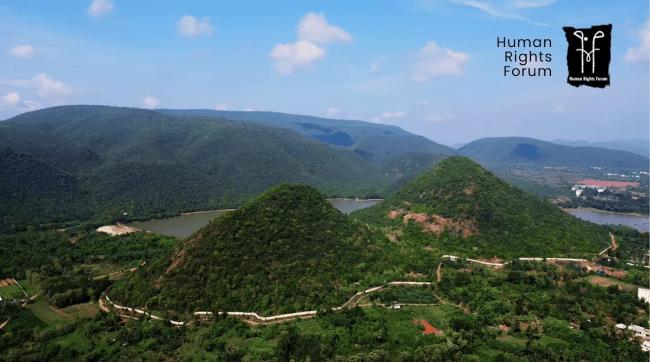
Beneath the sunny skies of Visakhapatnam, a quiet transformation is underway—one that promises to reshape India’s digital future while raising urgent questions about sustainability, sovereignty, and the true cost of “progress.”
American tech giants are pouring billions into hyperscale data centers along India’s eastern coast. But as the servers hum to life, communities, ecosystems, and democratic institutions may bear the hidden price.
🏗️ The $15 Billion Bet: Visakhapatnam’s Data Center Boom
At the heart of this surge is a landmark project: a $15 billion hyperscale data center near Visakhapatnam, reportedly a partnership between Google, AdaniConnex, and Airtel Nxtra. If completed as planned, it will be the largest facility of its kind in India—and just the beginning.
📊 The Scale of Ambition
| Metric | Target |
|---|---|
| 💰 Initial Investment | $15 billion (Google-Adani-Airtel project) |
| ⚡ Planned Capacity by 2030 | 5 gigawatts (GW) of data center power |
| 🏢 Companies Allocated Capacity | Google, Meta, Reliance, TCS, and 6+ others |
| 🌐 Strategic Infrastructure | 3 subsea optical fiber cable landings on Visakhapatnam coast |
🌍 Why Visakhapatnam? The Allure for Silicon Valley
Tech billionaires aren’t choosing Visakhapatnam by accident. A confluence of factors makes this port city uniquely attractive:
✅ Ready Availability of Land
Unlike congested metro hubs, Visakhapatnam offers expansive, relatively affordable coastal land—critical for facilities that can span hundreds of acres.
✅ Pro-Tech Political Leadership
Andhra Pradesh Chief Minister N. Chandrababu Naidu has positioned the state as an AI and data center-friendly destination, actively courting global investment with streamlined approvals and incentives.
✅ Strategic Digital Connectivity
Three subsea optical fiber cable landings along the Visakhapatnam coast promise:
- 🚀 High-bandwidth connectivity to Asia, Europe, and the U.S.
- ⏱️ Reduced latency for real-time AI applications
- 🌐 Gateway status for Silicon Valley to access Indian markets and talent
✅ Generous Policy Incentives
The Union Budget’s tax holiday extending to 2047 for data center investments creates a powerful financial pull—effectively guaranteeing decades of favorable treatment for early movers.
“This isn’t just about infrastructure. It’s about positioning India as the backend of the global AI economy.”
— Union IT Minister Ashwini Vaishnaw, at Google facility foundation ceremony (April 2026)
⚠️ The Hidden Costs: Environmental and Social Perils
While the economic promise is compelling, the environmental and social implications demand serious scrutiny.
💧 Water Scarcity in a Water-Stressed Region
Hyperscale data centers are notoriously thirsty:
- A single large facility can consume millions of liters of water daily for cooling systems
- Visakhapatnam and surrounding districts already face declining groundwater tables
- Agriculture-dependent communities risk further strain on vital water resources
🔌 Massive Energy Demand
- Operating at 5 GW capacity would require power equivalent to several mid-sized cities
- Despite renewable energy commitments, much of India’s grid remains coal-dependent
- Carbon emissions from backup generators and grid reliance could undermine climate goals
🏘️ Community Disruption
- Land acquisition for data centers can displace farmers, fisherfolk, and informal settlements
- Rising property values may price out long-term residents
- Local economies tied to traditional livelihoods face uncertain transitions
🗣️ The Silence of Opposition
Unlike protests against industrial projects in other parts of India, public resistance to Visakhapatnam’s data center push has been minimal or nonexistent. Reasons may include:
- Limited awareness of long-term environmental impacts
- Economic promises of jobs and development overshadowing concerns
- Political alignment between state and central governments reducing avenues for dissent
🤖 The Bigger Picture: AI, Sovereignty, and the Future of Work
The Visakhapatnam data centers aren’t just about storing data—they’re about power.
🌐 Gateway to Governance?
As Union Minister Vaishnaw noted, these facilities could serve as Silicon Valley’s gateway to India. But what does that mean for democratic autonomy?
🔹 In the UK, entire government departments now rely on U.S.-based AI companies for critical functions
🔹 In India, similar dependencies could emerge—raising questions about data sovereignty, algorithmic accountability, and policy influence
💼 The Employment Paradox
While data centers create high-skilled technical jobs, they may also:
- Displace workers in traditional IT services through automation
- Concentrate wealth in corporate hands rather than broad-based local development
- Exacerbate India’s existing unemployment crisis if job creation doesn’t match scale of investment
🌱 Sustainable Development or Extractive Growth?
The central tension: Can India harness the economic benefits of hyperscale infrastructure without repeating the environmental and social costs seen in other rapidly industrializing regions?
🔍 What’s Being Done? Gaps and Opportunities
Current Safeguards
✅ Environmental Impact Assessments (EIAs) required for large projects
✅ Corporate commitments to renewable energy procurement
✅ Government incentives tied to “green” data center certifications
Critical Gaps
❌ Water usage caps specific to data centers in water-stressed zones
❌ Community consent mechanisms beyond formal land acquisition processes
❌ Transparency requirements for energy sourcing and carbon accounting
❌ Local benefit-sharing frameworks to ensure communities gain from development
Pathways Forward
🔹 Mandate water recycling and zero-liquid discharge for all new data centers
🔹 Require renewable energy procurement as a condition for tax incentives
🔹 Establish community advisory boards for ongoing monitoring and grievance redressal
🔹 Invest in local skill development to ensure Andhra Pradesh residents can access high-value jobs
💡 For Stakeholders: Questions to Ask
For Policymakers
- How will water and energy allocations for data centers be balanced against agricultural and household needs?
- What safeguards exist to prevent over-reliance on foreign AI providers for critical public functions?
For Companies
- Are sustainability commitments backed by transparent, third-party verified reporting?
- How are you engaging with local communities beyond regulatory minimums?
For Communities
- What information do you have about projected water/energy use and mitigation plans?
- What channels exist to raise concerns or seek accountability?
For Citizens
- How can we ensure that India’s digital transformation serves public interest, not just corporate profit?
- What role can civil society play in shaping responsible tech policy?
🌟 Final Thought: Progress with Purpose
Visakhapatnam stands at a crossroads.
The arrival of hyperscale data centers offers a chance to position India at the forefront of the AI revolution—to create jobs, attract investment, and build world-class digital infrastructure.
But it also presents a test: Can we pursue technological advancement without sacrificing environmental integrity, social equity, or democratic sovereignty?
The choices made today—in boardrooms, ministries, and communities—will echo for generations.
As servers spin up along the Andhra coast, let’s ensure that the story they tell isn’t just one of speed and scale, but of wisdom, justice, and shared prosperity.
Because the future of technology should serve people—not the other way around.